Hard anodising line for aluminium parts
Price from-to, depending on configuration
150,000-400,000 EUR (EXW)
Price depends on configuration. Informational only (Art. 71 Polish Civil Code), not a binding offer. Verified: 2026-07-18.
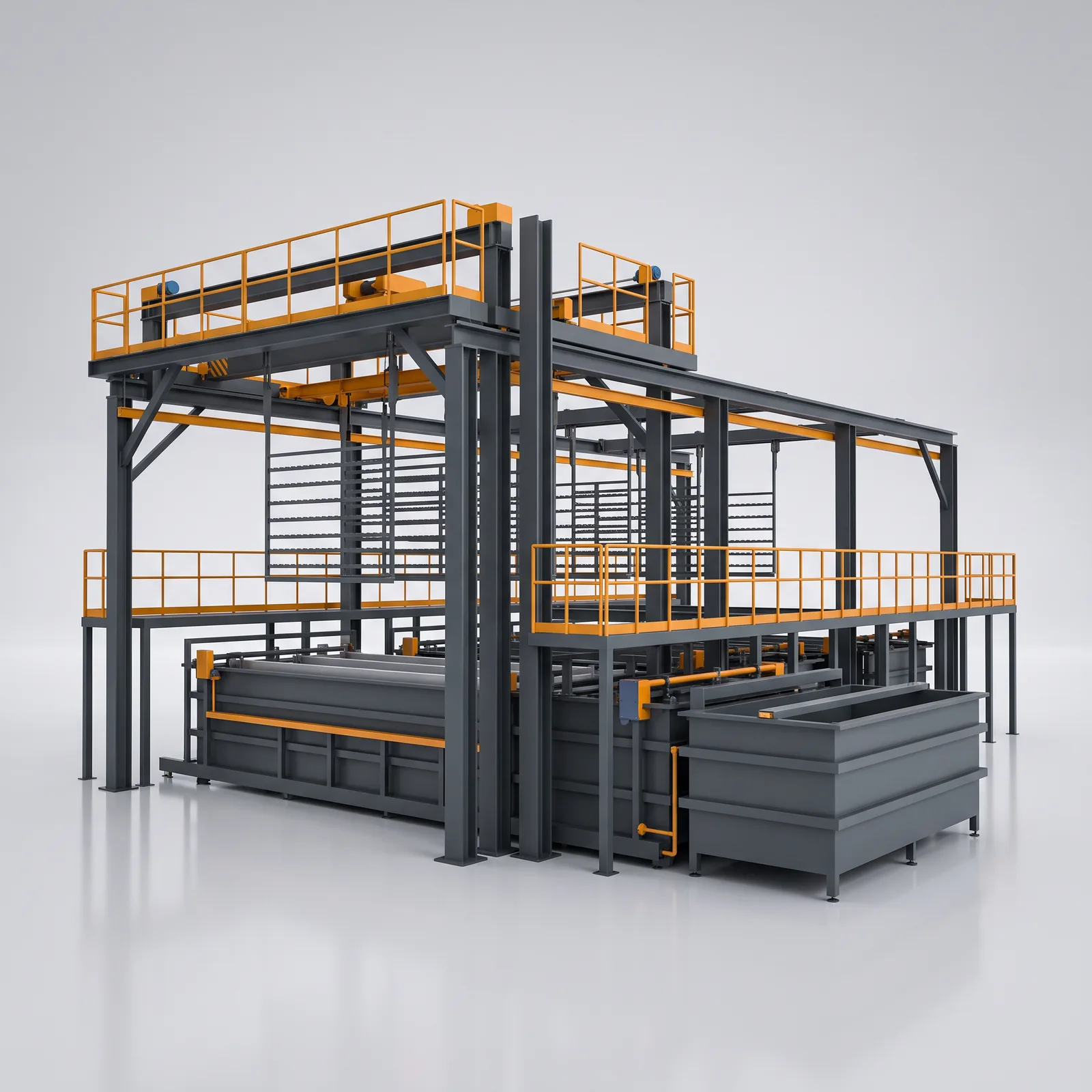
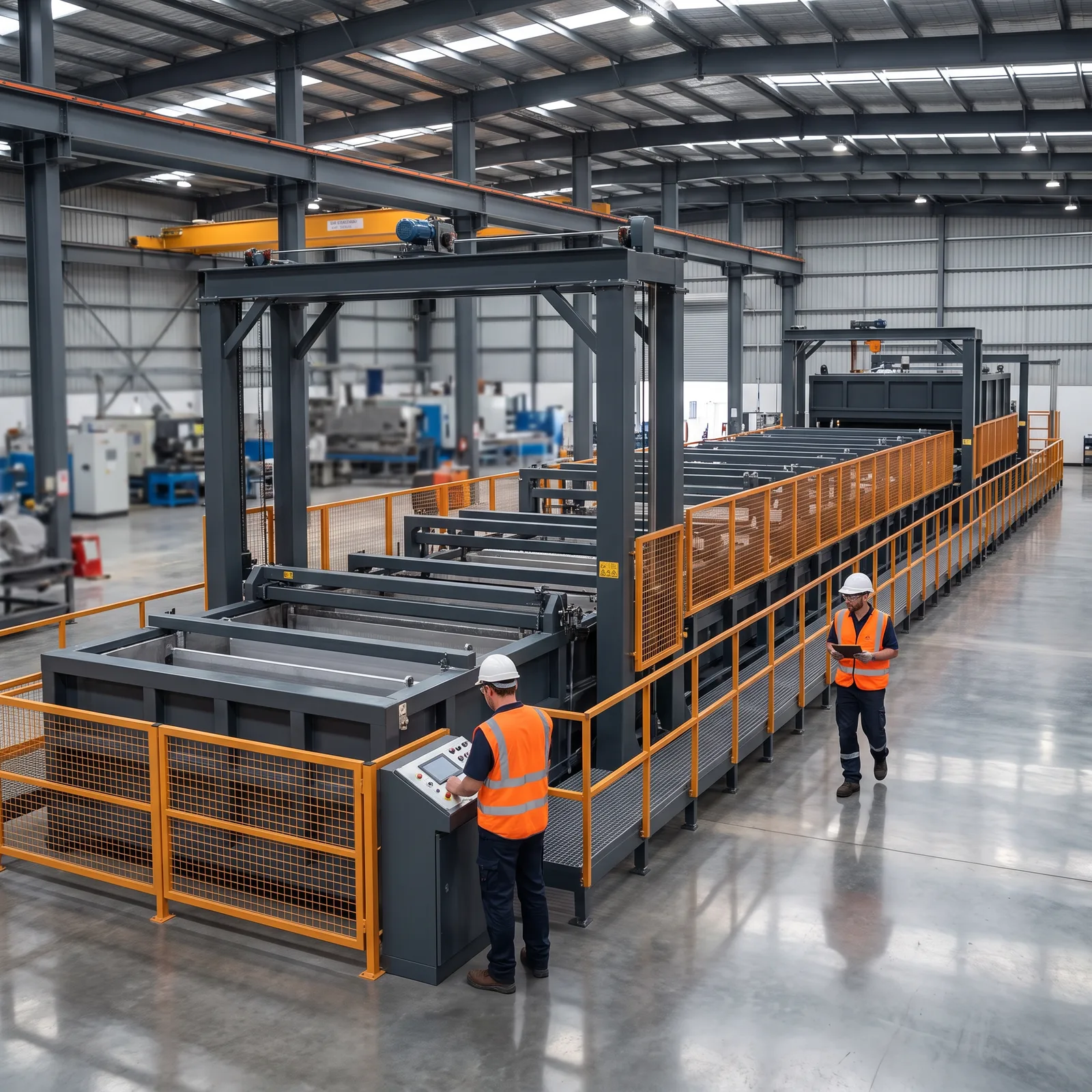
Hard coat anodising plays in a different league from decorative profile anodising: an oxide layer of 20-50 μm (standard anodising typically tops out around 25 μm), with hardness approaching hardened steel and wear resistance good enough for metal-on-metal duty. It is also a different market: instead of 6-metre architectural profiles, the racks carry precision aluminium parts: hydraulic rods and cylinders, pneumatic components, automotive parts, chiller and heat-exchanger elements, defence and aerospace hardware.
The process physics is demanding. The thick layer grows at a current density of 2.5-4 A/dm² (several times higher than decorative work), and the bath has to be held between -5 and +5°C, otherwise the coating comes out soft and porous. We say it plainly: at these currents the tank heats up fast, and the chiller with titanium heat exchangers is, next to the rectifier, the largest single item in the investment and a permanent energy cost. Any quotation that glosses over cooling is mis-priced. A 30 μm coating takes roughly one hour, so throughput is counted in batches of parts, not tonnes per month.
The scope of supply covers process tanks with acid circulation and cooling, a water-cooled pulse rectifier, degreasing and etching stations, hot sealing, a drying oven and rack transport: manual, semi-automatic or fully automatic with a PLC-controlled overhead crane. Tank dimensions are sized to your parts, not the other way round.
The factory-standard line requires EU conformity work before operation. We describe the scope and cost honestly (CE marking of Chinese machinery) instead of promising turnkey CE. Send your part drawings and monthly volumes via the contact page and we will size the tanks, rectifier and chiller for you, a process US buyers know as hard coat aluminum anodizing (Type III).
Specification
| Coating thickness | 20-50 μm (standard anodising: typically up to 25 μm) |
|---|---|
| Current density | 2.5-4 A/dm² |
| Bath temperature | -5 to +5°C (chiller included in scope) |
| Process time | approx. 1 h for a 30 μm coating |
| Automation | manual / semi-automatic / fully automatic with PLC crane |
| Rectifier | pulse type, water-cooled |
| Scope of supply | tanks, cooling & circulation, degreasing, etching, sealing, drying oven, rack transport |
CE status
CE: machine requires EU conformity work, we arrange a compliance quote
Linia w standardzie fabrycznym wymaga dostosowania do wymogów UE (wygrodzenia, wentylacja stanowisk kwasowych, obwody bezpieczeństwa, dokumentacja w języku polskim). Zakres i koszt dostosowania wyceniamy przed transakcją. Nie obiecujemy „turnkey CE”.
→ How we workTransaction terms
- Production lead time: 16-24 wks
Applications
Hydraulic rods, pistons and cylinders, pneumatic components, automotive parts, chiller and heat-exchanger elements, defence and aerospace hardware, moulds, guides and tooling exposed to wear.
Who it is for
CNC machining shops and job-shop anodisers adding hard coat capability; hydraulics and pneumatics manufacturers insourcing coatings; automotive and defence subcontractors with coating requirements on the drawing.
FAQ
How much does a hard anodising line cost?
Indicatively €150-400k EXW. The lower end is a manual line for smaller parts; the upper end a fully automatic plant with PLC crane and extended cooling capacity. The range is public; the exact quote is sized to your part dimensions and planned utilisation.
Why must the bath run between -5 and +5°C?
At higher temperatures the acid dissolves the coating faster than it grows, leaving it soft and porous. At 2.5-4 A/dm² the tank generates serious heat, so chiller capacity effectively limits line throughput, which is why we size it with margin and price it as a visible line item.
Can I hard anodise on a standard profile anodising line?
Only partly: you need a higher-voltage pulse rectifier and several times more bath cooling; without them you will not get past roughly 25 μm. We quote the retrofit of an existing plant as an alternative to a new line.
What about CE?
The factory-standard line needs EU conformity work (guarding, ventilation of acid stations, safety circuits, documentation). We arrange the compliance quote before purchase and state plainly who formally bears conformity responsibility in your setup.